Showing posts with label China Mieville. Show all posts

Tie for 2010 Hugo Award For Best Sci-fi Novel

The 2010 Hugo Awards were announced last weekend in Melbourne, Australia. As I expected, China Miéville's acclaimed novel The City & The City (see MadProfessah's B+ review) was the winner of the Hugo Award for Best Novel. That's not a surprise. What is a surprise is that there was another winner, despite the fact that the voting process used is preference voting (like the Oscar ballots, voters rank the nominees in order of their preference for what they want to win the prize).

The other Hugo Award winner for Best Novel is Paolo Bacigalulpi's The Windup Girl, which Time magazine listed as one of the Top 10 reads of 2009. I haven't read it, yet, but it is now on my Amazon wishlist.

The organizers of AussieCon4 have released statistics of the vote (pdf) in this year's Hugo awards and the Best Novel balloting is fascinating:


The City & The City by China Miéville (winner) The Windup Girl by Paolo Bacigalupi (winner)
240 240
240 240
264 254
292 275
323 308
380 380


The two winners were tied in 3 of the 6 rounds, with Miéville having a lead in the unimportant middle rounds. The only rounds which are determinative are the 1st and last rounds, and there the two were completely tied. The last time there was a tie in the Hugo Award for Best Novel it was between two of my favorite books of all time, in 1993 Doomsday Book (read MadProfessah's A review) by Connie Willis and A Fire Upon The Deep (see MadProfessah's A review) by Vernor Vinge.

It should be noted that the only time there has ever been a tie in Oscar voting is in 1968 for Best Actress when Katharine Hepburn in The Lion in Winter and Barbara Streisand in Funny Girl tied. The Academy sadly does not release the results (ever!) of Oscar balloting.

2010 Hugo Nominations Announced

The list of nominations for the 2010 Hugo Awards has been announced and the nominees for best science fiction novel are:
  • Boneshaker, Cherie Priest (Tor)
  • The City & The City, China Miéville (Del Rey; Macmillan UK)
  • Julian Comstock: A Story of 22nd-Century America, Robert Charles Wilson (Tor)
  • Palimpsest, Catherynne M. Valente (Bantam Spectra)
  • Wake, Robert J. Sawyer (Ace; Penguin; Gollancz; Analog)
  • The Windup Girl, Paolo Bacigalupi (Night Shade)
Interestingly, three of these books are also on the 2010 Nebula Awards list: The City & The City, Boneshaker and The Windup Girl. The only one of the nominees that I have read is The City & The City and I am a huge fan of Miéville, if not this particular book. I adored Robert Charles Wilson's Spin but have not been able to finish a single book of his since, even though at this point he must be considered a perennial nominee (I didn't get past page 50 of Julian Comstock before gratefully returning it to the library). The description of Robert J. Sawyer's Wake sounds like it will be the only other Hugo nominee that I will be attempting to read in the near future. I've read his Hominids series and he seems to be better at ideas than implementation.

The City & The City is turning out to be the most highly acclaimed speculative fiction book of the past year, having been nominated for the Hugo, Nebula, British Science Fiction Award and Arthur C. Clarke Award and according to Mark at Walker of Worlds has just won the BSFA. Since he's a Brit he can't be nominated for the Pulitzer but perhaps he'll get shortlisted for The Man Booker? Has any speculative fiction scaled such critical heights before?

2009 Nebula Award Nominations Announced

The nominations for the 2009 Nebula Awards for best work in speculative fiction were announced on Friday.
The Windup Girl, Paolo Bacigalupi (Nightshade, Sep09)
The Love We Share Without Knowing, Christopher Barzak (Bantam, Nov08)
Flesh and Fire, Laura Anne Gilman (Pocket, Oct09)
The City & The City, China Miéville (Del Rey, May09)
Boneshaker, Cherie Priest (Tor, Sep09)
Finch, Jeff VanderMeer (Underland Press, Oct09)
The only one of these that I have even heard of is China Miéville's The City & The City, which I recently reviewed. Last year's winner was Ursula K. LeGuin's Powers (which I have also previously reviewed). The top awards in science fiction writing are the Hugo Awards (voted on by fans) and the Nebula Awards (voted on by authors).

A rare number of books have won both awards, and they are often some of my favorite reads.

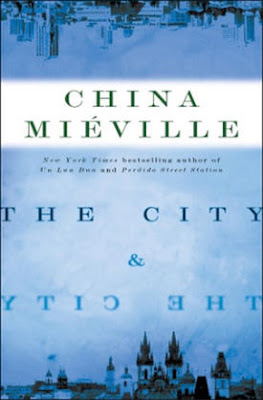
BOOK REVIEW: China Miéville's THE CITY & THE CITY

China Miéville, brilliant author of The Scar and Perdido Street Station is back on the top of the critics lists with his latest work, The City & The City.

I am a huge fan of China Miéville's previous fantasy work, and I'm also a big fan of mysteries, so when I heard that the genre-defying British author's latest book was a noir thriller I was excited and intrigued.

The City & The City is a very unusual book (as expected from Miéville) built from a mundane beginning: the body of a murdered woman is found in a bad part of a city and an experienced detective is assigned to the case.

The detective is
Inspector Tyador Borlu and the city is Beszel. The other city is Ul Qoma. The city & the city somehow occupy the same geographical space, in what the author calls a "crosshatching" where the residents of each city have their own language, food, culture, dress but have to consciously avoid acknowledging the existence of the other twin city, or be accused of "Breach."

Breach are the mysterious enforcers of the separation between the two cities. Both sides fear breach, and as the story unfolds breach takes on larger-than-life status.

Miéville does an interesting job of subverting and supporting the murder mystery/detective thriller format.

Overall, I was somewhat disappointed by
The City & The City. I'm not sure if it is because I had such high expectations from Miéville due to my love of his previous fantasy novels The Scar and Perdido Street Station. One big difference between those works and this latest work is the length. The City & The City is barely half the length of either of those works, and is nowhere as multi-threaded and multi-faceted as those works. This may be due to the form, itself, which of course has an overarching plot imperative: Will the detective solve the mystery and catch who committed the murder?

I think what happens in The City & The City is that the plot is so dominated by this one theme that even the bizarre setting of the two cities is not enough to maintain the level of fascination that Miéville is usually able to sustain when he is creating a work free of the constraints of a specific format like that imposed by the detective procedural.

If you have already read the other Miéville books, I would recommend starting with those and skipping the trip to The City & The City.

Author: China Miéville.
Title: The City & The City.
Length: 336 pages.
Publisher:
Del Rey.
Date:
May 26, 2009.

OVERALL GRADE: B+ (3.4/4.0).

PLOT: A-.
IMAGERY: A-.
IMPACT: B.
WRITING: B+.

My Favorite Books of the Decade 2000-2009

Thank goodness for school holidays. Thanks to this academic hiatus, I have been able to post my favorite films of the decade and my favorite television shows of the decade. Now comes my favorite books of the decade. It should be noted that these are books that were published between January 1, 2000 and December 31st, 2009 and read by me during that period. On Thursdays, I will try to regularly review either a movie or film in 2010.
Here are some capsule reviews of some of my favorite books, with full reviews accessible by clicking on the titles.
10. Fledgling. The final work from one of my favorite science-fiction authors who unfortunately died during this decade, in 2006. Octavia Butler was one of the very few African-American women to write in this genre, and she was quite successful, with her writing winning both of the highest accolades in the field, the Hugo and Nebula awards. Fledgling is Butler's re-imagining of the vampire myth, with the lead character being a genetically modified member of the Ina race, who appears to be a 13-year-old black girl but who is actually a 53-year-old creature who feeds on humans in symbiotic, mutually pleasurable relationships. As usual, Butler's work deals provocatively with issues of race, power, Author: Octavia Butler. Released: 2005.

9. Anathem. One of the most highly regarded science fiction books of 2009 gets on the list for its sheer inventiveness. Neal Stephenson is well-known for his genre-busting works such as Snow Crash, Cryptonomicon and his New York Times best-selling works of historical fiction that make up the Baroque Cycle. His books are generally huge and Anathem is no exception. This time Stephenson is playing with several different speculative fiction forms: alien first-contact, potboiler set in an insular academic/religious community, and road trip/quest. The story is told as a first-person narrative by a Fraa Erasmas who appears to be some kind of monk in an order devoted to the contemplation of mathematics and science. In fact, a slightly skewed look at mathematics and science play an integral role in the book, because Stephenson uses an encyclopedia of neologisms in the text to describe topics familiar to any college math/science major--half the fun of the book is trying to figure out what basic mathematical concept he is referring to using faux ancient terminology. The plot is a delightful romp and one is sad but satisfied when the book comes to an exciting conclusion. Author: Neal Stephenson. Released: 2009.
8. The Nine. The only work of nonfiction on my list of favorite books of the decade. Generally, I prefer fiction, and speculative fiction, at that, when I read. However, I am intensely interested in United States constitutional law, and so the Supreme Court is a hobby of mine. One of my all-time favorite books is Edward Lazarus' Closed Chambers: The Rise, Fall and Future of the Modern Supreme Court. Jeffrey Toobin's The Nine is an updated version of this insiders look at the inner workings of the SCOTUS. It is an absolutely fascinating read for anyone who has ever cursed the name of Antonin Scalia. Author: Jeffrey Toobin. Released: 2007.
7. Southland. An absolutely brilliant book which combines many of my favorite things: Los Angeles, law, mystery, history, openly gay characters, and an intellectually interesting analysis of race and gender. Southland is set in three different times: the 1930s south Los Angeles, the 1965 Watts riots, and post-Rodney King uprising West Los Angeles. The main character is Jackie Ishida, a Japanese-American lesbian law student, who together with an African-American guy named James Lanier attempts to figure out why her grandfather bequeathed nearly $40,000 in cash to a black guy named Curtis Martindale that she had never heard him mention before. It is a family drama, murder-mystery and historical fiction, all tied together with excellent plotting and well-crafted writing. I wish all mystery novels were as engrossing and meaningful as Southland. Author: Nina Revoyr. Released: 2003.
6. Cloud Atlas. This book was given to me by a friend who thought I might like it without telling me anything about it. It's a perfect way to encounter David Mitchell's brilliant onion of a novel. It was only after I finished reading it that I discovered how well-regarded and highly celebrated Cloud Atlas is. There is a brilliant conceit to the novel which I do not want to reveal, but suffice it to say that whatever your favorite genre is, you will not be disappointed. (I should warn you that Cloud Atlas still gets this high a ranking in my favorite books of the decade despite the fact that there were probably 50 pages in the middle of the book that I skipped unread without any loss of enjoyment in the novel, and without substantially detracting from my overall evaluation of the book as a masterpiece.) Author: David Mitchell. Released: 2004.

5. Perdido Street Station and/or The Scar. Hello, Hollywood? Miéville writes the most imaginative and terrifying "weird fiction" (as he himself calls it) of anyone writing in speculative fiction today (that I have read). Unfortunately for Hollywood, the books are probably unadaptable even in these post-Avatar days. I discovered Perdido Street Station by looking for sci-fi/fantasy novels that had won multiple awards at AwardAnnals.com and China Miéville was the only author at the time who had two books in the Top 20 whom I had never heard of! Lots of people either hate or love his work, but I was completely blown away by both Perdido Street Station and its "sequel" The Scar. I put both books on the list of my favorites for the decade because they are both excellent and I didn't want to choose one over the other. Both books are set in the city-state of New Crobuzon on the planet of Bas-Lag, one of the most intriguing and well-imagined locales in all of speculative fiction. However, I found the third book set in New Crobuzon, Iron Council, almost unreadable. It has sat by my bedside for nearly 6 months, untouched past the third chapter. Interestingly, there are almost no characters shared between the three books except New Crobuzon itself. That, and the fertile imagination of the author, are the real attraction here. It is a place you will not soon forget. Author: China Miéville. Released: 2000 and 2002.

4. Unaccomplished Earth. When people ask me who my favorite author is, I almost always immediately reply "Jhumpa Lahiri." She writes about the immigrant experience of Bengali (South Asian) people trying to assimilate, acclimate and accomodate "American" values. Although, I am not Bengali, since I am an immigrant from the Caribbean I think the universal nature of her description of the experience of how outsiders become insiders resonates deeply with me and any other group of people who feel marginalized in this culture. Plus her prose is simply beautiful and her plotting is generally surprising and realistic. In the past decade Lahiri also released her first novel, The Namesake, which was made into a well-regarded film starring Irfan Khan and Kal Penn, but I think it is in her short stories that Lahiri gets the reader to spend just the right amount of time with her characters, instead of the extended commitment of a full novel. Accustomed Earth is her second collection of short stories, her first (in my opinion, inferior) collection, Interpreter of Maladies won the Pulitzer Prize for Fiction in 2000. Author: Jhumpa Lahiri. Released: 2008.

3. The Name of the Wind. The best fantasy novel I have ever read, and that probably includes The Lord of the Rings. What makes The Name of the Wind so compelling is that it blends multiple genres. It is a coming-of-age tale, a mystery, a orphan-makes-good story and a memoir. For good measure, it is also set in a school of magic, like the esteemed Hogwarts in the Harry Potter novels! This is just the first book in what the author calls The Kingkiller Chronicles. It is hard to imagine that the next book (The Wise Man's Fear) can live up to the first, but even if it is only half as good, it will be a remarkable achievement by this first-time author. Author: Patrick Rothfuss. Released: 2007.

2. The Brief Wondrous Life of Oscar Wao. A heartbreaking work of staggering genius. Winner of the Pulitzer Prize for Fiction in 2008. A stunning melange of sci-fi/fantasy geekdom and Dominican Republic history and folklore, wrapped around an immigrant story and an impossible love story. Although this is one of the few books in my Top 10 that I have not re-read, I think it is because the memory of how shattered I was by reading the ending the first time still haunts me. Author: Junot Diaz. Date Released: 2007.

1. Pandora's Star & Judas Unchained. Although not as overwhelming as his reputation-ensuring Night's Dawn trilogy, Pandora's Star and Judas Unchained (sometimes called The Commonwealth Saga) are a monumental work in their own right. I disagree with critics who think that what the author begins in the first book he fails to bring to a satisfying conclusion in the second book. In all honesty, they are really one huge masterwork which the economics of modern publishing required to be split into two parts. Clearly, the author must be enamored of the vibrant, complex, exciting universe that he created in these books because he has returned to them in his next huge work, the excellent Void Trilogy, whose first two books The Dreaming Void and The Temporal Void have been released already, to mostly ecstatic reviews. I believe that the enthusiasm with which the Void Trilogy books have been greeted with is animated by residual good feeling from those who have read and enjoyed the Commonwealth Saga. It should be noted that these new books are an interesting departure for Hamilton since they feature a well-written and engaging plot thread which is almost entirely fantasy-based instead of the military space opera hard sci-fi for which he is most well-known and appreciated. I have re-read all four books Hamilton has published this decade and can honestly say they have given me the most enjoyment of anything that I have read since 2000. Author: Peter F. Hamilton. Released: 2005 & 2006.
Honorable Mentions: Jonathan Strange & Mr Norrell by Susannah Clarke, The God Delusion by Richard Dawkins, The Lies of Locke Lamora by Scott Lynch, Resurrection Men by Ian Rankin, The Emperor of Ocean Park by Stephen L. Carter, The Girl with the Dragon Tattoo by Stieg Larsson, Harry Potter and the Deathly Hallows by J.K. Rowling, The Golden Compass by Philip Pullman, Middlesex by Jeffrey Eugenides and Spin by Robert Charles Wilson.

Best Book Read This Decade (Published Before 2000): Doomsday Book by Connie Willis.

BOOK REVIEW: China Miéville's THE SCAR

China Miéville's The Scar is another incredible work of fiction by this little-known, but award-winning author of speculative fiction.

Although, not as haunting as his breakthrough work Perdido Street Station (see MadProfessah's review here), The Scar is equally inventive and enthralling.

Again set on the planet of Bas-Lag, where his signature creation, the city of New Crobuzon, is situated, this time, most of the action takes place far far away from the city, but again the central characters are (displaced) residents of that intriguing, terrifying metropolis.

The Scar is clearly Miéville's homage to Melville's Moby Dick. One of the central plot threads in the book is a search for a long-rumored mythical beast, a gigantic sea creature large enough to dwarf, and tow, a floating city. This is just one of the many intriguing story lines in the book, which also features pirates, vampires, humans genetically modified to breathe underwater and stigmatized inter-species sexual liaisons.

In The Scar, the main character of the book is female, Bellis Coldwine, a translator of languages who finds herself on a boat destined for a port halfway on the other side of the world, fleeing from her beloved New Crobuzon because of her actions (and reactions) to the horrific events chronicled in Perdido Street Station. Bellis is an interesting, somewhat detached and not altogether sympathetic protagonist. Miéville makes the common mistake of having his protagonist a witness to a few too many pivotal moments in the plot, but this reader is appreciative of the use of this common writer's device.

There is nothing common about The Scar or the imagination of China Miéville--read this book and you will be uncommonly entertained.

Length: 656 pages.
Publisher:
Del Rey.
Date:
June 25, 2002.

OVERALL GRADE: A/A+.

PLOT: A+.
IMAGERY: A+.
IMPACT: A-.
WRITING: A.

BOOK REVIEW: China Miéville's PERDIDO STREET STATION

China Miéville's Perdido Street Station is an incredible work of speculative fiction. It won the Arthur C. Clarke award and was nominated for both the Hugo and Nebula awards, the two most prestigious awards in science fiction and fantasy books.

Miéville's work is incredibly complex, weird and engrossing. It is somewhat reminiscent of the work of Octavia Butler in its singular views of alien sex, compellingly detailed depiction of complex societies and intricate plots.

Perdido Street Station is a gripping, horrifying read which epitomizes the very best of speculative fiction.

The story is set in New Crobuzon, a sprawling, dirty, bustling metropolis on an alien world which is probably Miéville's most signal literary achievement. New Crobuzon is a city-state as rich, diverse and powerful as ancient Rome or Athens. It is populated with various kinds of creatures, the most prominent of whom are humans, khepri (they have insectoid heads on human female bodies), cactacae (humanoid-cactus hybrids) and vodyanoi (aquatic beings with webbed feet who can manipulate water to form structures and can not survive without getting their skin wet for more than a day).

The plot is so complex it is difficult to be easily summarized (this is a common problem with Miéville's books) but the most memorable strand to me centers around common nightmares which everyone in the City starts having, which (unsurprisingly) turn out to be related to the fact that certain people are not waking up at all...

Oh, and there's a geeky mad scientist, The Devil himself and an uprising of an enslaved underclass--and those are just story elements!

Perdido Street Station is not for everyone, but I bet that almost everyone will enjoy it.

Length: 640 pages.
Publisher:
Del Rey.
Date:
July 29, 2003.

OVERALL GRADE: A/A+.

PLOT: A.
IMAGERY: A+.
IMPACT: A.
WRITING: A.